In the past ten years, a single international policy framework has drawn participation from more than one hundred and forty countries. This reach spans Asia, Africa, Europe, and Latin America. It stands as one of the most far-reaching global economic initiatives in recent history.
Commonly framed as fresh trade routes, this BRI Unimpeded Trade is far more than building projects. At its core, it strengthens stronger capital connectivity along with economic cooperation. Its objective is joint growth through extensive consultation and joint contribution.
By shrinking transport costs while creating new economic hubs, the network operates as a catalyst for development. It has channelled large-scale capital with support from institutions like the Asian Infrastructure Investment Bank. Projects run from ports and railway lines through to digital connections and energy links.
But what tangible effects has this connectivity had within global markets and regional economies? This analysis explores a ten-year period of financial integration efforts. We’ll look at both the opportunities created and the contested challenges, including debt sustainability.
We start with the historical vision of revived trade corridors. From there, we assess the present-day financial mechanisms and their practical impacts. Lastly, we look ahead toward future prospects within an evolving global landscape.
Core Takeaways
- The initiative connects over 140 countries across multiple continents.
- It focuses on financial connectivity and economic cooperation, not just infrastructure.
- Core principles include extensive consultation and shared benefits.
- Key institutions such as the AIIB help finance a range of development projects.
- The network is designed to cut transport costs and generate new economic hubs.
- Debates persist around debt sustainability and project transparency.
- This analysis follows its evolution from past roots toward future directions.
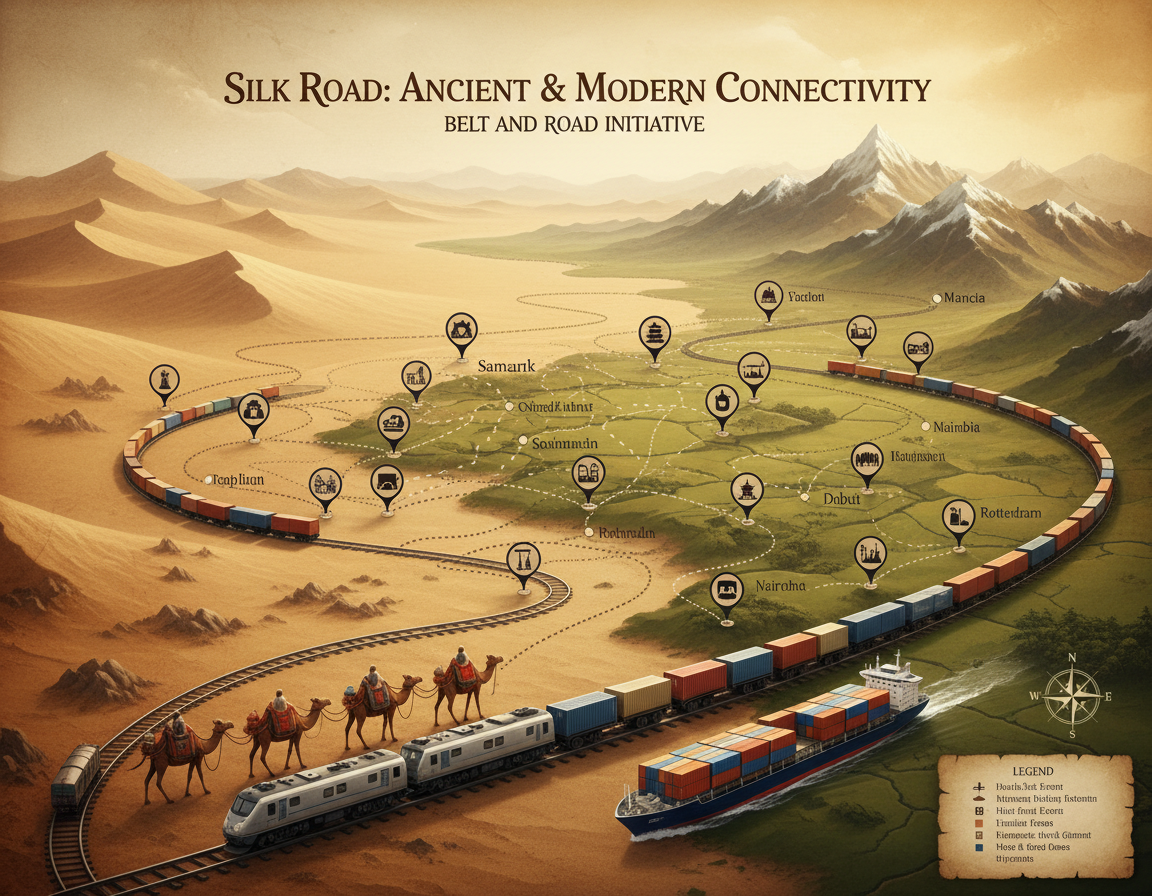
Introducing The Belt & Road Initiative (BRI)
Centuries ahead of modern globalization, a network of trade corridors linked distant civilizations across vast continents. These old routes moved more than silk and spices across borders. They conveyed ideas, technologies, and cultural practices across Asia, the Middle East, and Europe.
This historic concept is being revived today. Today’s belt road initiative builds on those ancient links. It reimagines them for contemporary economic needs.
From Ancient Silk Routes To A Modern Development Blueprint
The early silk road operated between the 2nd century BC and the 15th century AD. Caravans journeyed enormous distances in harsh conditions. These routes were the internet of that age.
They enabled the movement of goods like textiles, porcelain, and precious metals. More significantly, they shared knowledge, religions, and artistic traditions. That connectivity shaped the medieval landscape.
Xi Jinping unveiled a creative revival of this concept in 2013. This vision aims to enhance cross-regional connectivity on a massive scale. It looks to build a new silk road for the modern era.
This modern framework addresses today’s development challenges. Many countries seek infrastructure investment and trade opportunities. This framework offers a platform for shared solutions.
It amounts to a major foreign policy and economic approach. Its aim is broad-based growth across participating countries. This approach differs from zero-sum geopolitical competition.
Core Principles: Consultation, Joint Contribution, Shared Benefits
The BRI Financial Integration enterprise is grounded in three central ideas. These principles shape every partnership and project. They ensure the framework remains cooperative with mutual benefit.
Extensive Consultation means this is not a single-actor endeavor. All stakeholders have a voice in planning and implementation. The process respects varying development levels and cultural settings.
Partner countries engage openly on needs and priorities. This collaborative ethos defines the character of the initiative. It builds trust and durable partnerships.
Joint Contribution highlights that everyone plays a role. Governments, businesses, and communities bring strengths to the table. Each partner draws on their comparative strengths.
This might involve offering local labor, materials, or expertise. This principle helps ensure projects have collective ownership. Success depends on collective effort.
Shared Benefits emphasizes the win-win goal. Opportunities and outcomes should be distributed fairly. All partners should experience clear improvements.
These benefits may include employment gains, technology transfer, or market access. This goal aims to make globalization more even. It seeks to leave no nation behind.
Combined, these principles form a structure for cooperative international relations. They answer calls for a more inclusive world economy. This framework positions itself as a tool for shared prosperity.
Over one hundred and forty countries have taken part in this vision so far. They recognize potential in its approach to cooperative development. The sections that follow will explore how this vision turns into real-world impacts.
The Scope Of Financial Integration In The BRI
The physical infrastructure in the headlines is just one dimension of a far broader economic integration strategy. Ports and railways provide the physical connections, financial mechanisms enable these projects to happen. This deeper layer of cooperation turns isolated construction into lasting economic corridors.
Real connectivity requires aligned capital flows and investment. The model extends beyond simple construction loans. It includes a wide range of financial tools intended to drive long-term growth.
Beyond Bricks And Mortar: Building Financing For Connectivity
Financial integration acts as the essential fuel for physical connectivity. Without coordinated finance, big infrastructure plans remain plans. This strategy addresses that through a range of financing tools.
They include conventional project loans for construction. They also extend to trade finance that supports goods movement on new routes. Currency swap agreements help enable more seamless transactions between partner countries.
Investment into digital and energy networks draws significant attention. Modern economies require reliable power and data connectivity. Backing these areas supports comprehensive development.
This Belt and Road People-to-people Bond approach creates concrete benefits. Reduced transport costs make manufacturing more competitive. Businesses can place factories near new logistics hubs.
That clustering creates /”agglomeration economies./” Connected businesses cluster in specific areas. That increases productivity and innovation across broad sectors.
The mobility of resources improves significantly. Labor, inputs, and goods flow more freely. Economic activity rises along newly linked corridors.
Key Institutions: AIIB, And The Silk Road Fund
Specialized financial institutions have central roles in this strategy. They mobilize funding for projects that might seem too risky for traditional banks. They are focused on transformative development over the long term.
The Asian Infrastructure Investment Bank (AIIB) serves as a multilateral development bank. It counts around 100 member countries worldwide. This broad membership ensures multiple perspectives in project selection.
The AIIB prioritizes sustainable infrastructure in Asia and beyond. It applies international standards on transparency and environmental protection. Projects need to show visible development impact.
The Silk Road Fund operates differently. It is a Chinese state-funded investment vehicle. The fund supplies both debt and equity financing for targeted ventures.
It commonly partners with other investors on large projects. This collaboration shares risk and brings expertise together. The fund concentrates on commercially viable projects that have strategic significance.
Together, these institutions create a strong financial architecture. They direct capital toward modernization of productive sectors across partner nations. This supports moving economies higher up the value chain.
FDI gets a significant boost through these channels. Chinese companies gain opportunities in new markets. Local industries access technical know-how and expertise.
The goal is upgrading the /”productive fabric/” of partner countries. This includes building more sophisticated manufacturing capabilities. It also involves strengthening skilled workforces.
This integrated approach aims to lower the risk of major investments. It creates sustainable economic corridors rather than standalone projects. The focus remains on shared gains and mutual benefit.
Grasping these financial tools helps frame analyzing their real-world impacts. The next sections will explore how this capital mobilization translates into trade patterns and economic transformation.
A Decade Of Growth: Mapping The BRI Expansion
What began as a blueprint for revived trade corridors has developed into one of the largest international cooperation networks in contemporary times. The first ten-year period tells the story of remarkable geographic expansion. This expansion reflects global demand for connectivity solutions and development funding.
A map of participation makes clear the initiative’s sheer scale. It progressed from a regional initiative to global engagement. This growth was neither random nor uniform, instead following clear patterns tied to economic need and strategic partnership.
From 2013 To Today: A Network Of 140+ Countries
The effort began with the 2013 announcement outlining a new framework for cooperation. Every year that followed brought more signatories to the Memoranda of Understanding. These documents indicated formal interest in exploring collaborative projects.
Many participating nations joined in an initial wave of enthusiasm. The peak period extended between 2013 and 2018. In those years, the network’s basic architecture took shape across continents.
Today, the community includes more than 140 countries. This represents a large portion of countries worldwide. The collective population within these BRI countries spans billions of people.
Researchers including Christoph Nedopil track investment flows to outline the evolving scope of the initiative. No single official list of member states exists. Instead, engagement is tracked through signed agreements and projects implemented.
Regional Hotspots: Asia, Africa, And More
Participation is largely concentrated in specific geographical regions. Asia forms the central core of the belt road framework. Many nations here seek major upgrades to infrastructure systems.
Africa represents a major focus area too. The continent faces vast unmet needs for transport, energy, and digital networks. Numerous African countries have entered cooperation agreements.
The strategic logic behind this regional concentration is clear. It links production centers in East Asia to consumer markets in Western Europe. It additionally connects resource-rich areas in Africa and Central Asia to global trade corridors.
This geographic pattern supports wider economic development aims. It supports more efficient flows of goods and services. The network creates fresh corridors for commerce and investment.
The reach extends well beyond these two continents. Eastern European nations participate as gateways between Asia and the EU. Some nations in Latin America have also joined, seeking port and logistics investment.
This growth reflects a deliberate broadening of global economic partnerships. It extends beyond traditional alliance systems. This framework offers an alternative platform for collaborative development.
The map tells a story of opportunity-driven response. Countries with major infrastructure gaps saw promise in this partnership model. They engaged to find pathways to accelerate their own economic growth.
This geographic foundation helps frame practical impacts. The following sections will explore how trade, investment, and infrastructure have evolved among these diverse countries. The first decade laid the network; the next phase focuses on deepening its benefits.